
by: Wisdom Abella, Mary Armenion, and Julz Bardaje
Editor’s note: This article is written by undergraduate students from Ateneo de Manila University, taking their internship at BAN Toxics.
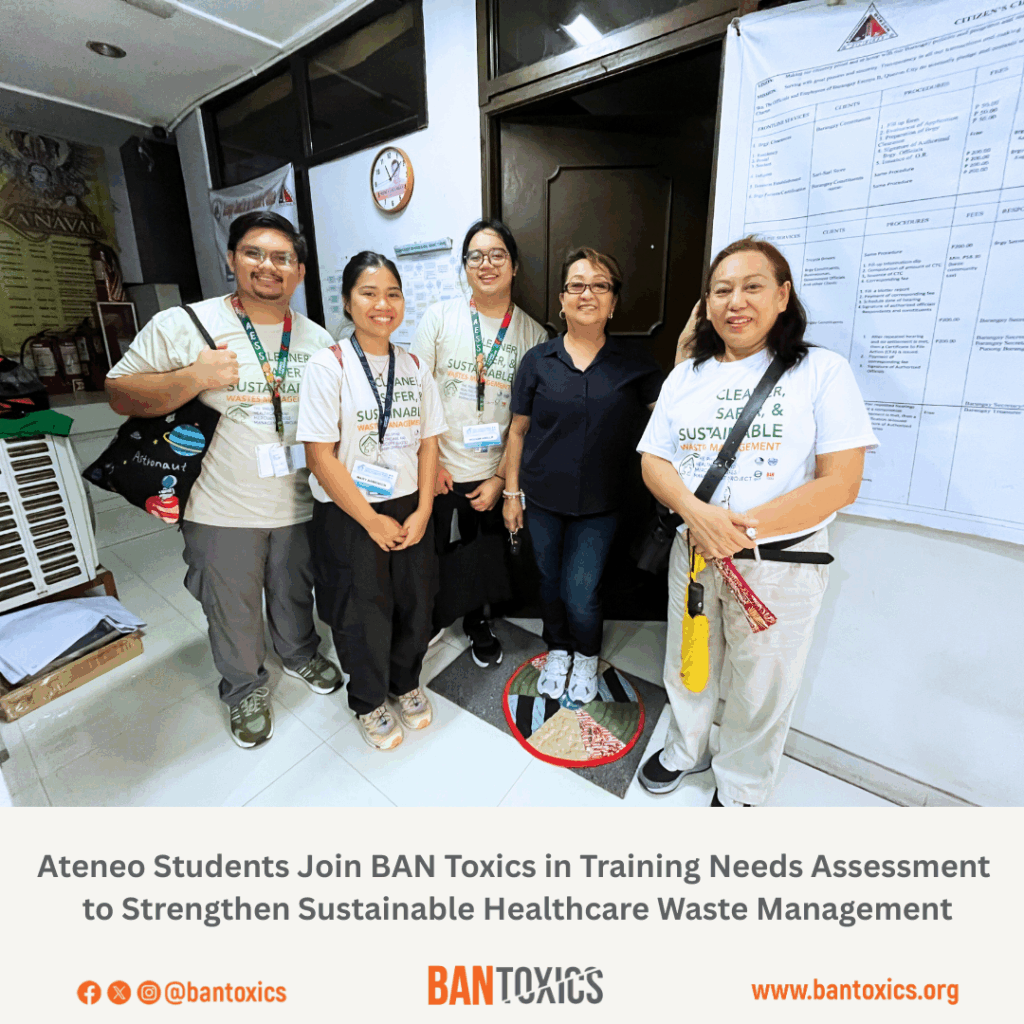
The United Nations Industrial Development Organization (UNIDO) and the Department of Environment and Natural Resources-Environmental Management Bureau (DENR-EMB) are currently implementing the Philippine Healthcare and Mercury Wastes Management Project (HCWM Project), which aims to improve the current state of healthcare waste management in the country. The five-year project, funded by the Global Environment Facility (GEF) and executed by civil society organization BAN Toxics, focuses on reducing releases and emissions of toxic substances from healthcare waste such as unintentional persistent organic pollutants (uPOPs) and mercury.
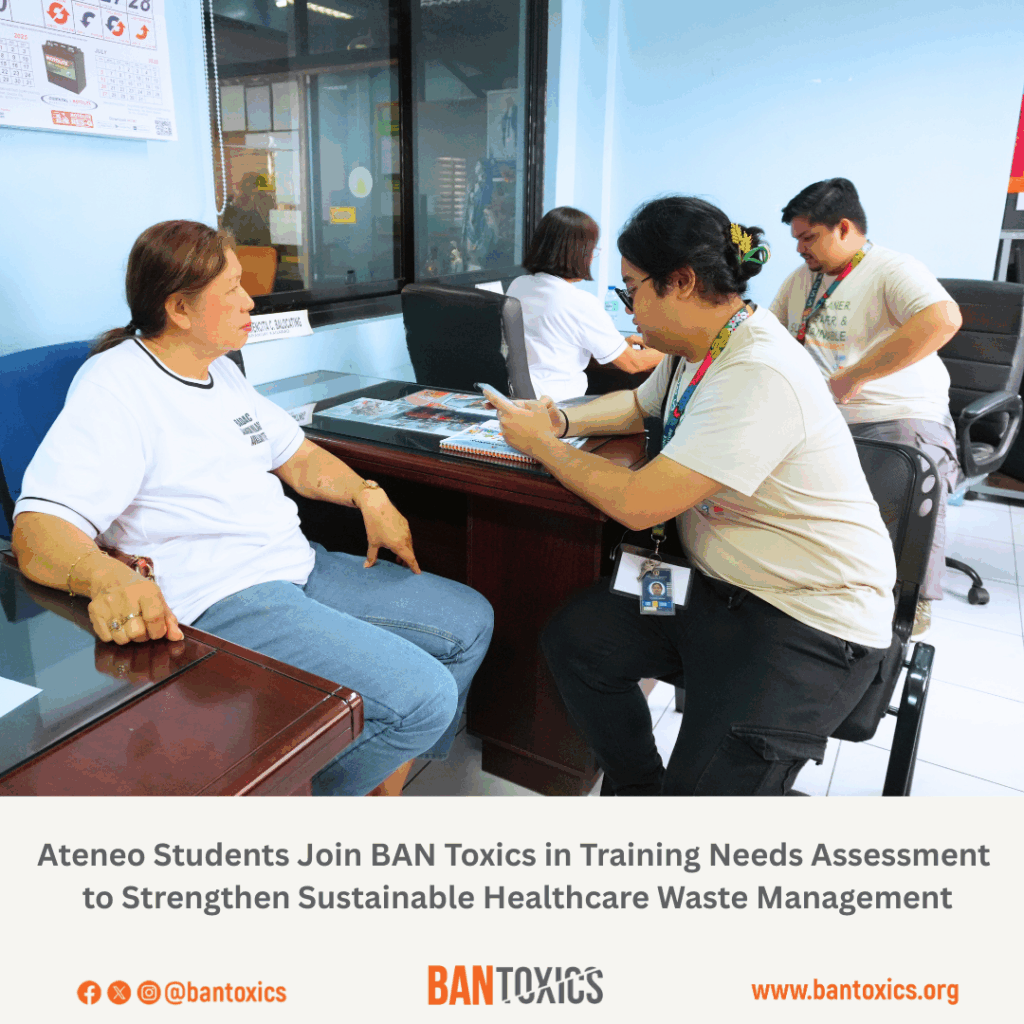
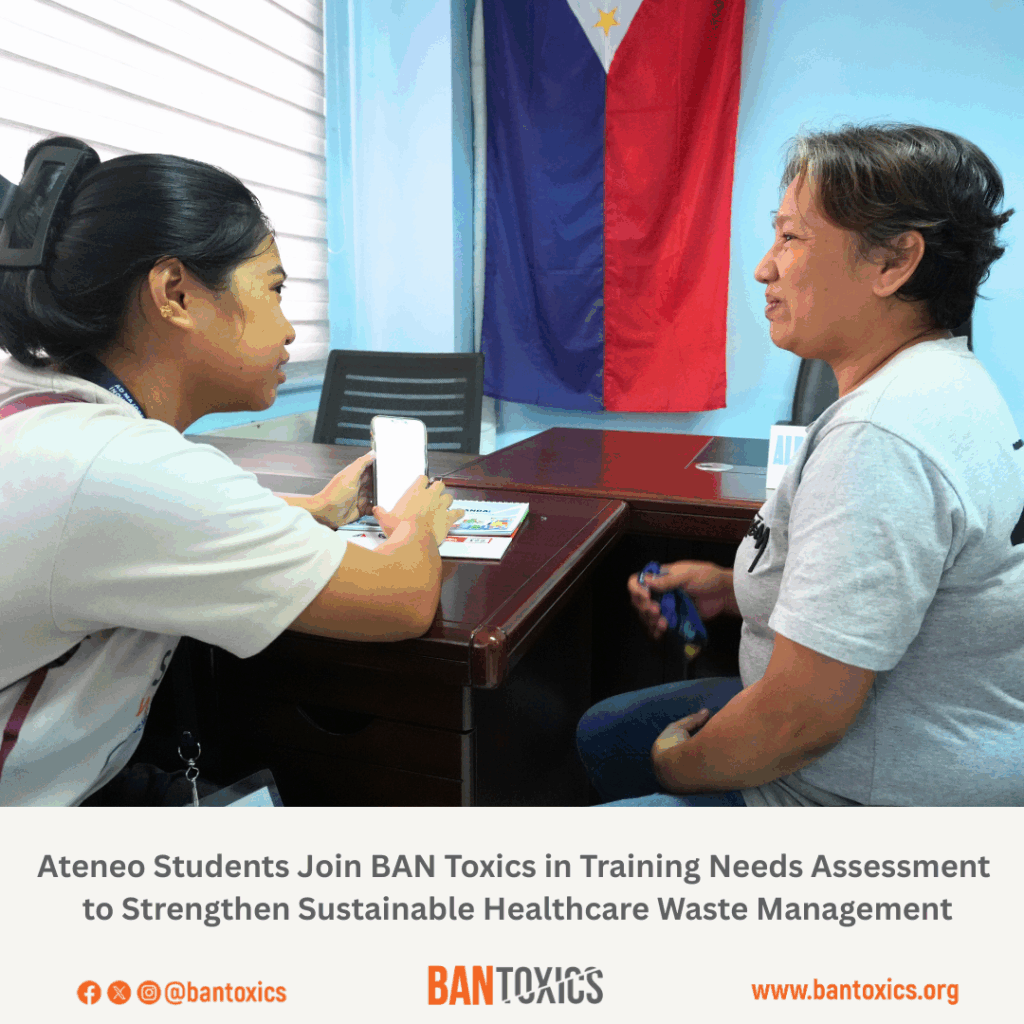
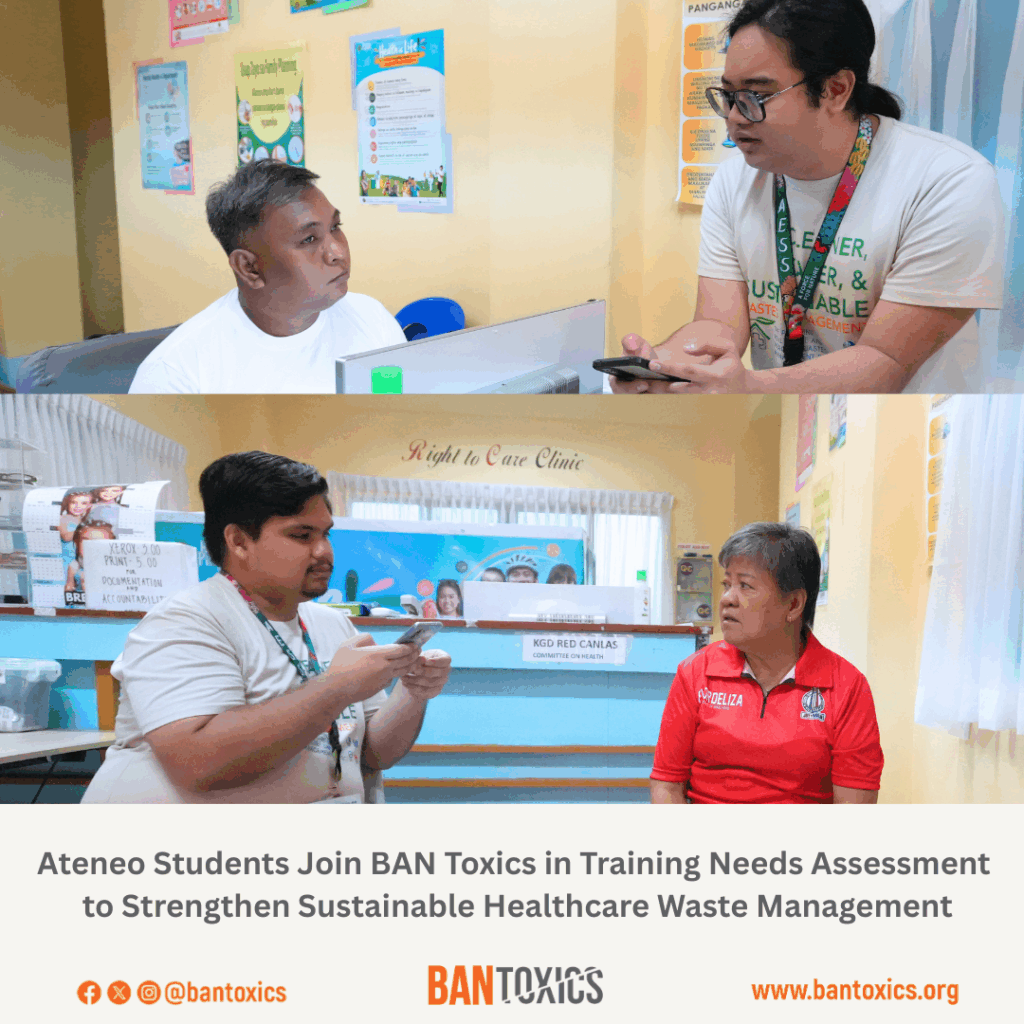
In line with its objectives, the HCWM Project conducted a Training Needs Assessment (TNA) survey from June 19-20, 2025 for 12 barangays located in close proximity to the project’s partner hospital, the Quirino Memorial Medical Center.
The survey was administered through interviewing the local government unit (LGU) employees’ current knowledge and background experience relating to both healthcare waste and its management. The data collected will allow the stakeholders to gauge the level of awareness, attitude, and skills of the LGU employees regarding healthcare waste management as well as formulate programs that will enhance the LGU’s overall approach towards medical waste management.
Healthcare Waste
According to the Health Care Waste Manual published by the Department of Health (DOH), healthcare waste includes the generation and production of waste resulting from the diagnosis, treatment, immunization, and research of humans or animals, production or testing of biologicals, and waste from minor or scattered sources.1
Additionally, the DOH has classified healthcare waste into different categories:
- General waste (domestic waste, no hazards posed)
- Infectious waste (contains pathogens that may causes diseases)
- Pathological waste (waste from human or animal bodies)
- Sharps (needles, syringes, scalpels, blades, etc. that may cause cuts or wounds)
- Pharmaceutical waste (expired, unused, spilt, and contaminated products or drugs)
- Genotoxic waste (substances with carcinogenic or mutagenic characteristics)
- Chemical waste (discarded solid, liquid, and gaseous chemicals)
- Waste with high content of heavy metals (highly toxic, mercury waste)
- Pressurized containers (aerosol cans or empty, of no use containers)
- Radioactive waste (liquid and gaseous materials exposed to radioactivity)
It is significant to manage and monitor the disposed healthcare waste as these may pose a risk to public health and the environment should it be mishandled. For instance, unsupervised wastewater from hospitals entering sewage systems may contain pathogens that can be infectious or be potential sources of pollution in bodies of water.
Moreover, Health Care Without Harm Southeast Asia, a non-governmental organization, also states that the existing methods of healthcare waste disposal undergo the processes of incineration, co-incineration, pyrolysis, and gasification which emit toxic pollutants containing lead, mercury, uPOPs such as dioxins and furans, as well as acid gases which may leach into soil and water harming the people and the environment.2
Healthcare waste’s overall contribution to the waste generation of the Philippines
Now, how does healthcare waste contribute to the overall waste generation in the country? The surge in healthcare waste during and after the COVID-19 pandemic has made the overall waste situation in the Philippines worse. From June 2020 to June 2021, the DENR reported that the country generated 634,687.73 metric tons of healthcare waste.3 At the peak of the COVID-19 pandemic, Metro Manila was generating as much as 280 metric tons of healthcare waste per day compared to the pre-pandemic, where the daily average was significantly lower, at 47 metric tons.⁴
In the year 2018, a waste audit by Health Care Without Harm Southeast Asia, reported about 46% to 72% of hospital waste was made up of single-use plastics, like syringes, PPE, packaging, IV tubes, and plastic bottles.5 Since these plastics are often contaminated, they are rarely recycled and usually end up in landfills, incinerators, or dumps, posing environmental threats.6
Furthermore, poor segregation of waste in hospitals and local government units makes the problem worse. Many of these healthcare facilities still face challenges when it comes to proper healthcare waste management.6 In particular, gaps in training and awareness have led to common issues in waste segregation, where recyclable plastics like bottles and packaging are often mixed with infectious or chemical waste. Once mixed, these materials are considered hazardous and can no longer be recycled.
In addition to this, places with limited waste management programs and treatment facilities often dump or incinerate these combined wastes in the open. Burning and dumping this waste releases harmful substances like dioxins, furans, as well as heavy metals, putting both people and the environment at risks.7
Challenges and opportunities in healthcare waste awareness at the barangay level
Out of the 12 barangays surveyed, the majority of the respondents were uncertain on the types of healthcare waste, its sources, treatment and impacts onto humans and the environment. In addition, most respondents also reported that they were unable to attend training programs on healthcare waste segregation.
Moreover, only 1 out of 12 barangays had informational posters classifying the different types of healthcare wastes posted in the office. It was also reported that only 1 out of 12 barangays had trash cans for infectious/hazardous wastes.
“The science is there and it’s sound. But the problem lies in the dissemination of it.” Wisdom, one of the BAN Toxics interns, exclaimed.
“There really is a need to put focus on more training programs and seminars on healthcare wastes, especially given that the barangays are in near proximity to a third-grade hospital.” Mary, another BAN Toxics Intern commented.
However, upon interviewing, respondents have also expressed their interest and eagerness to attend the necessary training programs, if made available and accessible to them. In addition, a majority, if not all of the respondents answered to attending training programs on general waste segregation or on programs related to R.A. 9003, Ecological Solid Waste Management Act.
“Although, what we have right now is already a great start: an eagerness to learn and knowledge on basic segregation… we just need to deepen it.” Julz, a BAN Toxics Intern concluded.
That being said, healthcare waste segregation is still far off from reaching zero impacts onto the community. Even more so, knowledge and awareness on healthcare wastes aren’t widely spread in its current state. But, given enough time and opportunities, an envisioned future of zero-waste can be seen on the horizon and there lies a community where healthcare waste is given priority.
References
[1] Department of Health. n.d. Revised Health Care Waste Management Manual. Available from: https://ntp.doh.gov.ph/download/health-care-waste-management-manual/
[2] Health Care Without Harm Southeast Asia, 2024. Position Paper on Plastics, WTE, Incineration, and Calls for Action. Available from: https://global.noharm.org/resources/position-paper-plastics-wte-incineration-and-calls-action
[3]DENR. 2021. How comprehensive and effective are waste management policies during the COVID-19 pandemic? Perspectives from the Philippines. Available from https://pmc.ncbi.nlm.nih.gov/articles/PMC9432801/
[4] Cabico, GK. August 27, 2020. In the Philippines, medical waste piles up as COVID-19 cases rise. Available from: https://earthjournalism.net/stories/in-the-philippines-medical-waste-piles-up-as-covid-19-cases-rise
[5] Health Care Without Harm. November 22, 2018. Philippines launches plastics healthcare report. Available from: https://asia.noharm.org/news/press-release-philippine-launch-plastics-healthcare-report
[6] Health Care Without Harm. n.d. Sustainability in healthcare. Available from: https://asia.noharm.org/sustainability-healthcare
[7]Minh NH, et al. 2003, March 6. Open dumping site in Asian developing countries: A potential source of polychlorinated dibenzo-p-dioxins and polychlorinated Dibenzofurans. Environmental Science & Technology. Available from: https://pubs.acs.org/doi/10.1021/es026078s