
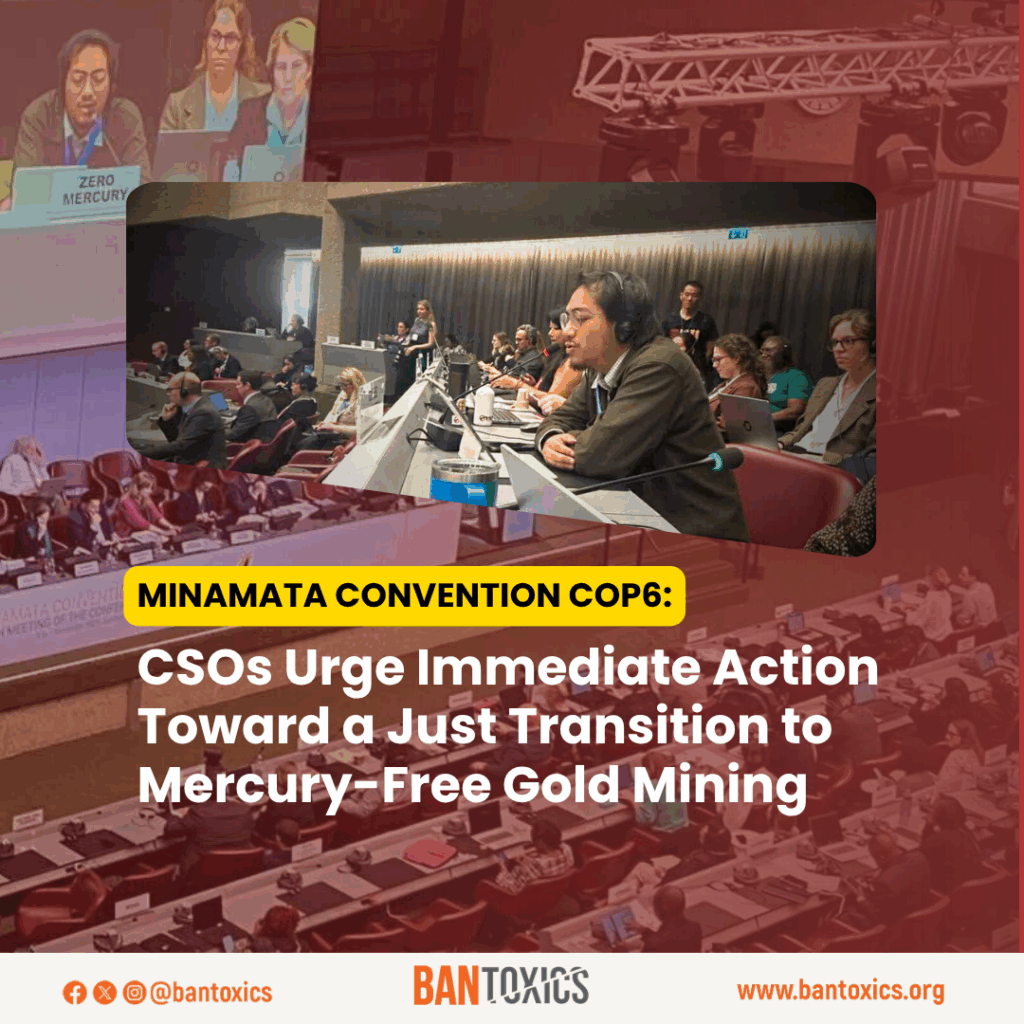
Geneva, Switzerland — As discussions at the 6th Conference of the Parties (COP6) to the Minamata Convention on Mercury [1] continue, civil society organizations belonging to the Zero Mercury Working Group (ZMWG) coalition delivered a statement during the plenary sessions on November 4, calling on governments to pursue a just transition to mercury-free gold mining.
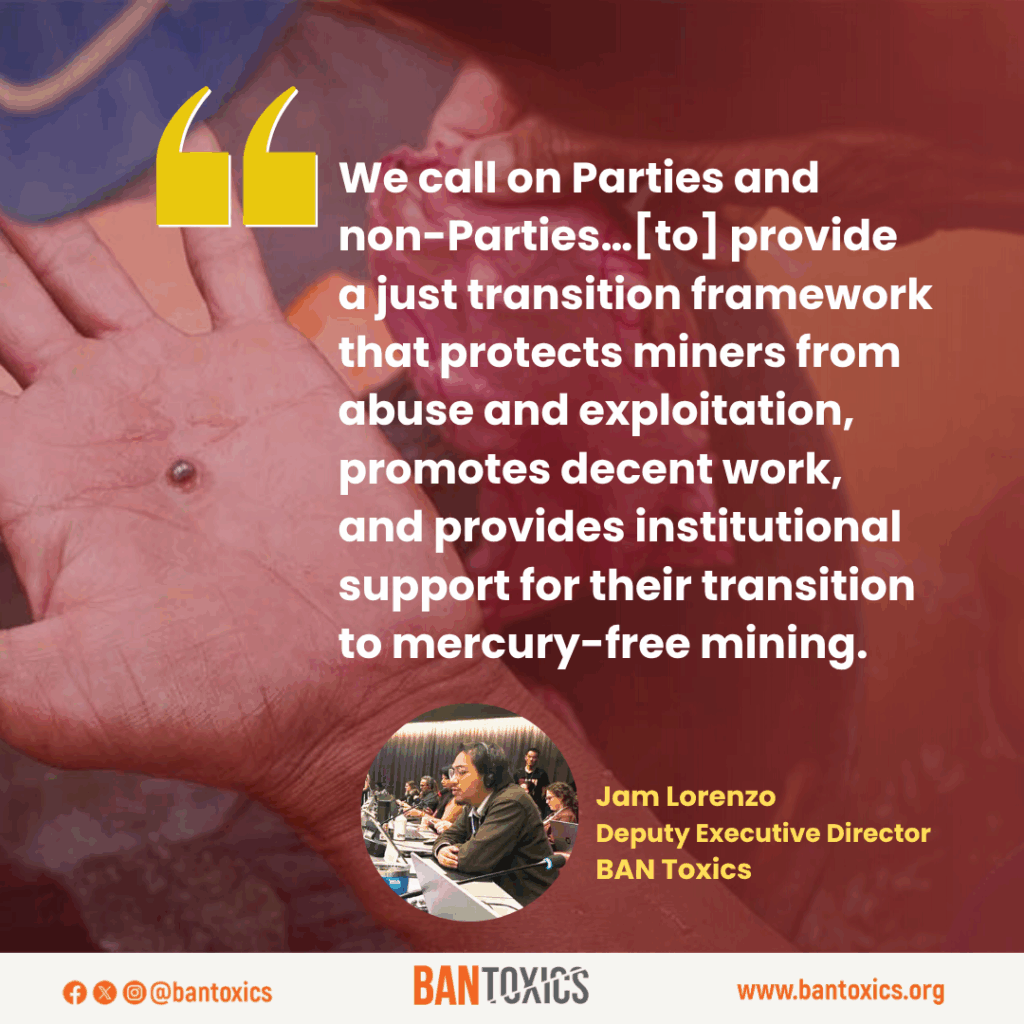
The statement, delivered by BAN Toxics’ Deputy Executive Director Jam Lorenzo on behalf of the coalition, called on both parties and non-parties [2] to the Convention to take stronger steps toward compliance. The coalition urged countries that have yet to do so to submit their National Action Plans (NAPs)[3] on ASGM, and reminded those that have already submitted to provide updates and reviews on their implementation progress.
The statement also highlighted that NAPs should “provide a just transition framework that protects miners from abuse and exploitation, promotes decent work, and provides institutional support for their transition to mercury-free mining.”
COP6 is being held in Geneva, Switzerland, from November 3 to 8, 2025, where delegates are reviewing global progress in reducing mercury use and emissions under the Convention. ZMWG, an international coalition of more than 110 environmental and health organizations from over 55 countries, is participating in COP6 to advocate for stronger global action to eliminate mercury use
Continuing Widespread Use of Mercury in ASGM
According to Lorenzo, evidence gathered by ZMWG members, including BAN Toxics, shows that mercury use in artisanal and small-scale gold mining remains widespread even in countries where it is banned, such as Uganda, South Africa, Kenya, and several Southeast Asian nations like the Philippines. This widespread use persists mainly because mercury enters countries through illegal trade and in various forms.
In a July 2025 report [4], the Environmental Investigation Agency (EIA) revealed that Mexican mercury mines, with some allegedly controlled by organized crime, are fueling a deadly supply chain linking gold mining, environmental destruction, and human rights abuses. The report also noted that rising gold prices have driven illegal ASGM deeper into South America’s rainforests, particularly the Amazon, increasing demand and profits for mercury traffickers.
Meanwhile, in the Philippines, an upcoming mercury material flow study commissioned by the Department of Environment and Natural Resources-Environmental Management Bureau (DENR-EMB) and implemented by BAN Toxics shows that mercury use in the ASGM sector far exceeds official import data, indicating that mercury continues to enter the country illegally.
Recent interviews conducted by BAN Toxics with small-scale mining operators revealed a monthly mercury use ranging from 20 to 40 kilograms. The miners reported that mercury is commonly bought from hardware stores and gold-buying shops near ASGM areas and is also available online. BAN Toxics’ online market monitoring has likewise identified several sellers of liquid mercury on platforms such as Facebook Marketplace, Lazada, and Shopee. These findings challenge an earlier national report that attributed mercury sources to diversion from dental amalgam use, and further point to illicit trade as the more likely source.
Just Transition
Ahead of COP6, BAN Toxics held a consultation with the National Coalition of Small-Scale Miners of the Philippines, Inc. (NCSSMPI) to discuss a proposal to the Minamata Convention on setting a phase-out date for mercury use in ASGM. The consultation underscored the need for a rights-based just transition framework that recognizes how mercury use in the sector is largely driven by poverty, limited capacity, and lack of access to safer technologies.
“While formalization efforts for ASGM operations are important, it may not be enough to address underlying socio-economic issues that drive the sector towards mercury-use. A rights-based just transition framework is crucial to protect small-scale miners from displacement, criminalization, and other social and economic harms,” Lorenzo said. “It must ensure meaningful community participation, respect local and indigenous knowledge, and promote affordable, accessible mercury-free technologies for the most vulnerable mining communities.”
Lorenzo added that with around 500,000 small-scale gold miners across more than 30 provinces, protecting their livelihoods must be central to the shift toward mercury-free mining.
Meanwhile, NCSSMPI emphasized that phasing out mercury use in ASGM must go hand in hand with efforts to address the global mercury trade.
Ending Mercury Production and Trade
The ZMWG also called for stronger international action to curb the illegal mercury trade and address remaining gaps in the treaty.
In its statement, the coalition further recommended “that COP-6 establish an inter-sessional open-ended expert group charged with making recommendations to COP-7 on accelerating the closure of primary mines, eliminate loopholes in the Convention that benefit traffickers and illegal gold miners, improve reporting on mercury trade, and identify enhanced enforcement measures necessary to eliminate the illegal production, trade, and use of mercury in ASGM.”
___________
[1] The Minamata Convention on Mercury is a global treaty adopted to protect human health and the environment from anthropogenic emissions and releases of mercury and mercury compounds. The Philippines signed the treaty on 10 October 2013 and formally ratified it on 8 July 2020, thereby becoming a Party and committing to its provisions.
[2] Parties to the Minamata Convention are countries that have ratified and are legally bound by the treaty’s provisions, while non-Parties are those that have signed but not yet ratified it.
[3] National Action Plans are official documents outlining a country’s strategies and measures to reduce, and where feasible, eliminate the use of mercury in artisanal and small-scale gold mining.
[4] Environmental Investigation Agency (2025). “Traffickers Leave No Stone Unturned: How Criminal Control of Mexico’s Mercury Supply Fuels a Global Trade in Poison.” Available at: https://eia.org/report/traffickers-leave-no-stone-unturned