
PRESS RELEASE | 29 July 2026
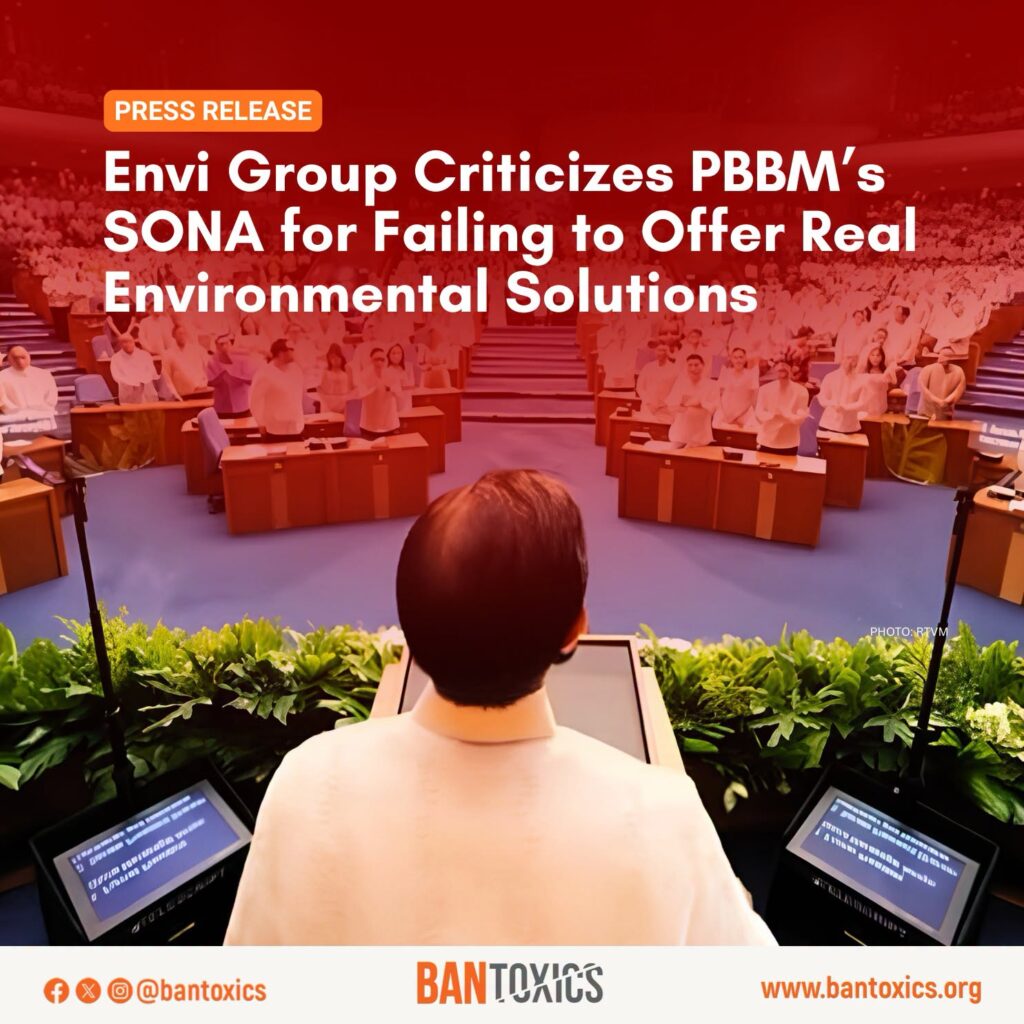
Environmental Justice Organization BAN Toxics expressed dismay over President Ferdinand “Bongbong” Marcos Jr.’s fifth State of the Nation Address for “lacking real solutions” to the country’s environmental issues. “What little we heard from the President that is related to the environment consists of false solutions. The general direction of the administration for its remaining years continues to be focused on serving private business and foreign investor interests at the expense of the Filipino people and the environment.”
The group is referring to waste-to-energy, fossil gas, nuclear power, and the Pax Silica initiative, mentioned during the President’s speech, which they say will only lead to further environmental degradation and harm to the people.
BAN Toxics Deputy Executive Director Jam Lorenzo zeroed in on the President’s mention of updating the 25-year-old Ecological Solid Waste Management Act, or RA 9003, to align it with waste-to-energy technology. According to Lorenzo, the government still seems to be deaf to the arguments of civil society groups and experts who have long criticized downstream measures such as WTE as false solutions.
“Burning waste will only transform it into other, often more toxic forms, such as dioxins, furans, along with hazardous fly ash and bottom ash, and air and water pollutants. It will not solve the waste crisis, and will instead only perpetuate the current system where industries continue to produce goods intended for disposal, such as single-use plastics. WTE might even incentivize further production of plastic goods that will eventually serve as feedstock for WTE, since WTE prefers dry, inorganic, fossil-derived plastic waste,” Lorenzo said.
Lorenzo added that the government should focus on strengthening the implementation of RA 9003, including the capacities of local government units, and find ways to truly implement the zero waste framework that will reduce the production of goods, redesign products and packaging for reuse and recyclability, and shift industries away from single-use, disposable materials.
The group also called attention to the ongoing entry of imported electronic waste, or e-waste, into the Subic Freeport, which it says should compel the government to ratify the Basel Ban Amendment. The group says that currently, the SBMA has become a hotbed of recycling of imported e-waste, with a possible 50% coming from the US. According to Lorenzo, importation of e-waste or other waste from the US is prohibited and deemed criminal under the Basel Convention, a global environmental treaty designed to combat toxic waste trade, to which the Philippines is a signatory.
“Under the guise of circular economy, we are becoming more and more a dumping ground of hazardous e-waste, which could potentially expose our waste workers, communities, and the environment to toxic substances. The ratification of the Basel Ban Amendment is long overdue. Adopting it should give us further protection from the dumping of waste from developed countries,” Lorenzo added.
The Basel Ban Amendment would prohibit Annex VII Parties to the Basel Convention—including OECD member countries that are Parties to the Convention, the European Union, and Liechtenstein—from exporting hazardous waste to developing countries like the Philippines.
“While the Philippines has not yet ratified the Ban Amendment, the US, as a non-party to the Convention, is still prohibited from exporting e-wastes to the Philippines.”
Lorenzo also warned that under Pax Silica, the same “circular economy” and “urban mining” justification might pave the way for more importation of e-waste, since it is one of the secondary sources of critical minerals for processing, which the initiative will supposedly be heavily focused on.
“We remain critical of Pax Silica and question the government’s rush to have this signed by November. Aside from growing concerns over potential environmental destruction, displacement of communities, and water and energy crises, we are also concerned about turning our country into a processing hub for critical minerals, including e-waste processing and recycling, which could release toxic waste, radioactive waste, and emissions of hazardous substances into the environment,” Lorenzo said.
BAN Toxics also raised red flags over the government’s push for fossil gas from Malampaya and nuclear energy, which they say will lock the country into decades of fossil fuel dependence, expose communities to safety and environmental risks, and divert resources away from cheaper, renewable energy solutions.
“The formula remains the same, where proposed solutions primarily benefit private businesses and investors. When will the government prioritize people and the environment over profit?” Lorenzo said.