
Groups call for the Philippine Government to Continue Upholding Basel Convention Treaty Obligations, Following Customs Action on Three Prior Suspect Containers
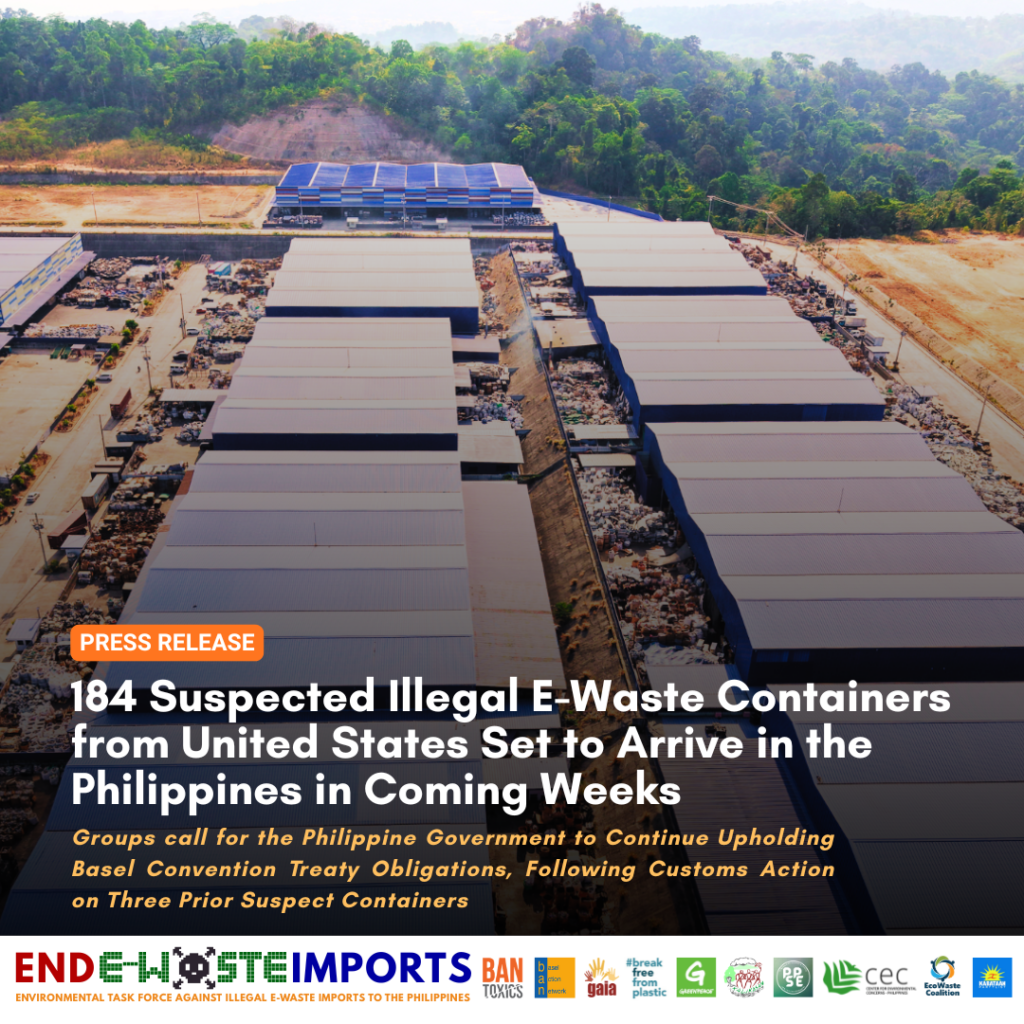
July 31, 2026: SEATTLE / MANILA — The Basel Action Network (BAN), together with members of the Philippine NGO Environmental Task Force Against Illegal E-Waste Imports to the Philippines (End E-Waste Imports), have sent out a new Operation Can Opener (OCO) alert, identifying 184 shipping containers suspected of containing illegally imported electronic waste, all coming from the United States (US).
The containers are scheduled to arrive at the Subic Bay Freeport Zone in the Philippines between August 6 and September 30, 2026.
The alert was sent on Wednesday, July 29, to the Bureau of Customs (BOC) Commissioner Ariel Nepomuceno and Environmental Management Bureau (EMB) Director Michael Drake Matias of the Department of Environment and Natural Resources (DENR) in the Philippines.
The warning follows a July 22 Bureau of Customs action on three prior containers flagged by BAN. BOC Subic District Collector Geniefelle Lagmay ordered the three suspect containers to remain on board the vessel MV Tokyo Express, citing the Philippines’ obligations under the Basel Convention and Republic Act 6969 to take a precautionary approach.
The Philippine Daily Inquirer reported on July 25, citing the BOC, that the containers had been declared on shipping documents as “scrap copper.” According to vessel tracking reviewed by BAN, the containers did not remain in Subic and were moved onward the day after the BOC order.
“We commend the Bureau of Customs for promptly acting on the prior alert and preventing suspected illegal waste trafficking from the US to the Philippines,” said Jam Lorenzo, Deputy Executive Director of BAN Toxics, one of the convenors of the Task Force. “But that was three containers. BAN has now identified 184 more suspected containers, and the government must respond with the same urgency and resolve.”
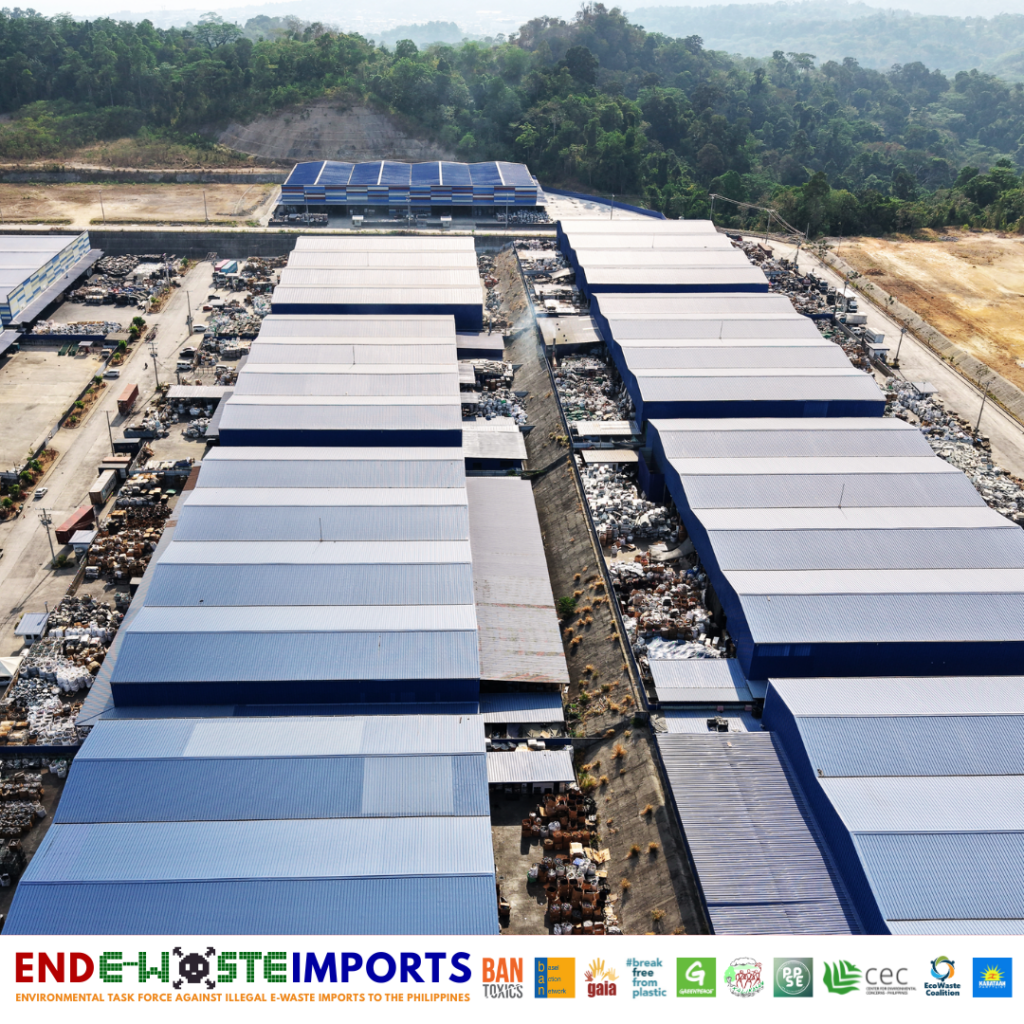
An aerial image shows recycling facilities inside the Subic Bay Freeport Zone. (Photo courtesy of Basel Action Network)
BAN and members of End E-Waste Imports, which includes BAN Toxics, Kalikasan People’s Network for the Environment, Greenpeace Philippines, and other civil society groups, are calling on the Philippine government to intercept, inspect, and prevent any confirmed illegal e-waste shipments from entering the country. The groups also emphasized the need for enforcement measures to prevent rejected shipments from simply being rerouted to another developing country.
To properly enforce the Basel Convention, the groups say Philippine authorities should detain and inspect the suspect containers to determine whether they indeed contain Basel-controlled e-waste. If the containers are confirmed to contain e-waste from the US, BAN and its Task Force partners maintain that they would be considered illegal traffic under the Basel Convention’s Articles 4(5) and 9.
In addition, following the E-Waste Amendments that entered into force in January 2025, nearly all e-waste – hazardous or not – is controlled under the Convention. The groups outlined this position in a July 15 civil society position paper submitted to DENR, BOC, and other agencies following a July 6 interagency meeting.
Under Article 4(5) of the Convention, Parties such as the Philippines may not permit the import of Basel-controlled waste from a non-Party (such as the US) without a valid Article 11 agreement in place, which would allow such trade but it must provide an equivalent level of environmental protection as the Convention. The US Environmental Protection Agency (EPA) and the State Department confirmed with BAN that no such agreement exists to allow e-waste exports from the US to the Philippines.
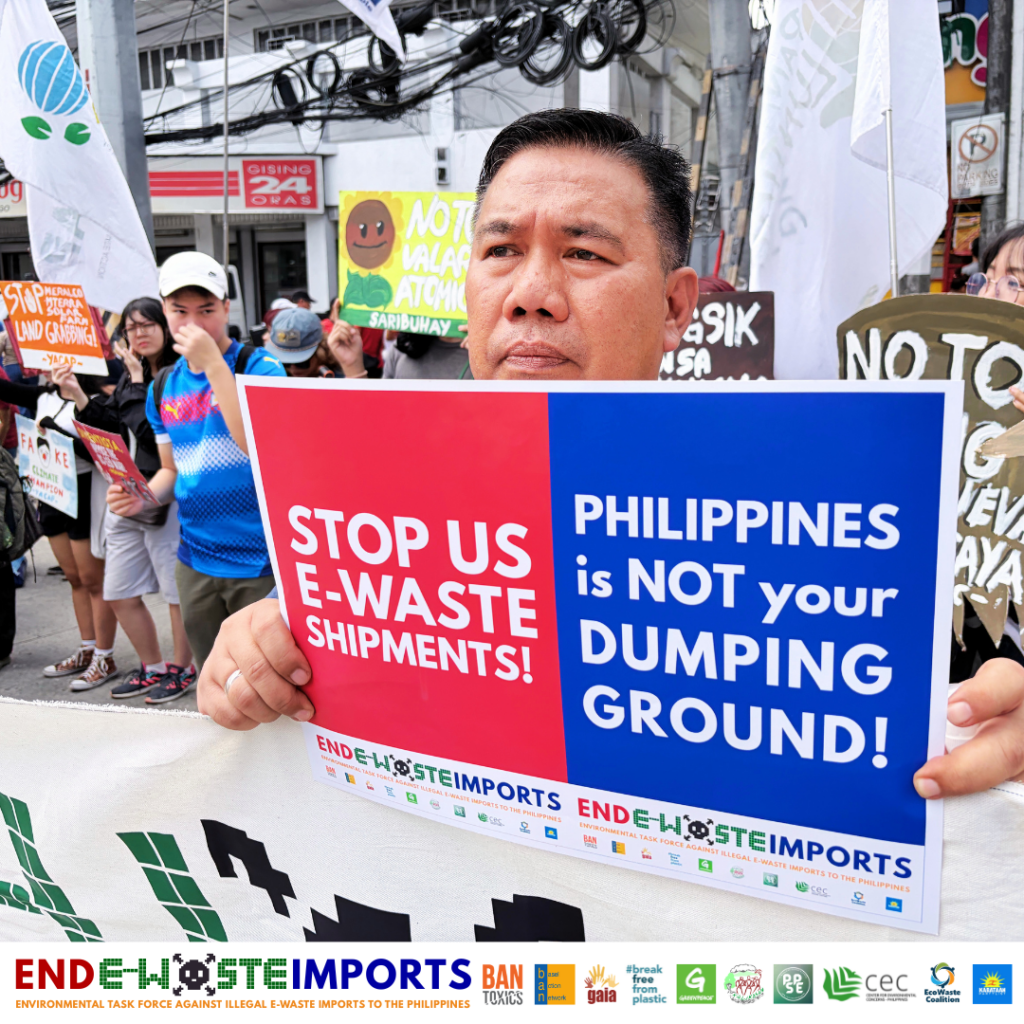
The END E-Waste Imports task force joined protests during the fifth State of the Nation Address of Philippine President Ferdinand Marcos Jr. on July 27, 2026. (Photo courtesy of END E-Waste Imports)
For containers found to contain illegal e-waste, the groups urge the Philippine government to use an existing bilateral agreement, signed in 2001, that covers hazardous waste moving from the Philippines to the US. This way, US authorities will be responsible to ensure that the waste is not re-exported by the original exporters.
“Sending these shipments back informally, container by container, is not enough. Because the US is not a Party to the Basel Convention, too often, the same waste can be simply rerouted to another unsuspecting country,” said Jim Puckett, Founder and Chief of Strategic Direction of BAN. “The existing bilateral arrangement that covers only exports from the Philippines gives the country a lawful path to ensure illegal e-waste is taken back by the US to be responsibly managed and recycled there – what should have been done in the first place.”
The Task Force urges authorities to prevent any new bilateral agreement between the US and the Philippines that would legalize e-waste exports from the US, warning of efforts by US lobbyists pushing for such an agreement. They also raise concerns over the planned US-led Pax Silica Initiative, which will set up an AI Industrial hub in the Philippines, with the processing of critical minerals as one of its core focuses. The groups warn that it might give way to an influx of e-waste from the US to the Philippines, under the framework of critical minerals recovery or “urban mining.”
Link to more photographs: https://drive.google.com/drive/folders/1e3PkeK5PrzEyiwTTAzdugqCFVqHTsvWh?usp=sharing
___
About the Basel Action Network
Founded in 1997, the Basel Action Network is a 501(c)3 charitable organization of the United States, based in Seattle, WA. BAN is the world’s only organization focused on confronting the global environmental justice and economic inefficiency of toxic trade and its devastating impacts. Today, BAN serves as the information clearinghouse on the subject of waste trade for journalists, academics, and the general public. Through its investigations, BAN uncovered the tragedy of hazardous electronic and toxic waste dumping in developing countries. For more information, see https://www.ban.org/
About the Environmental Task Force Against Illegal E-Waste Imports to the Philippines (End E-Waste Imports)
The Environmental Task Force Against Illegal E-Waste Imports to the Philippines was launched on June 25, 2026, to raise awareness on illegal e-waste imports, mobilize community action, and ultimately stop illegal e-waste shipments into the Philippines. The task force is composed of several environmental groups including BAN Toxics, Basel Action Network (BAN), Global Alliance for Incinerator Alternatives (GAIA) Asia Pacific, Break Free From Plastic – Asia Pacific, Kalikasan People’s Network for the Environment, Greenpeace Philippines, Ecowaste Coalition, Center for Environmental Concerns – Philippines, Pangasinan People’s Strike for the Environment, Central Luzon Environmental Action Network, and Kabataan Partylist.
https://bantoxics.org/2026/06/25/envi-groups-stop-us-e-waste-shipments-to-the-philippines/