
PRESS RELEASE | 12 August 2026
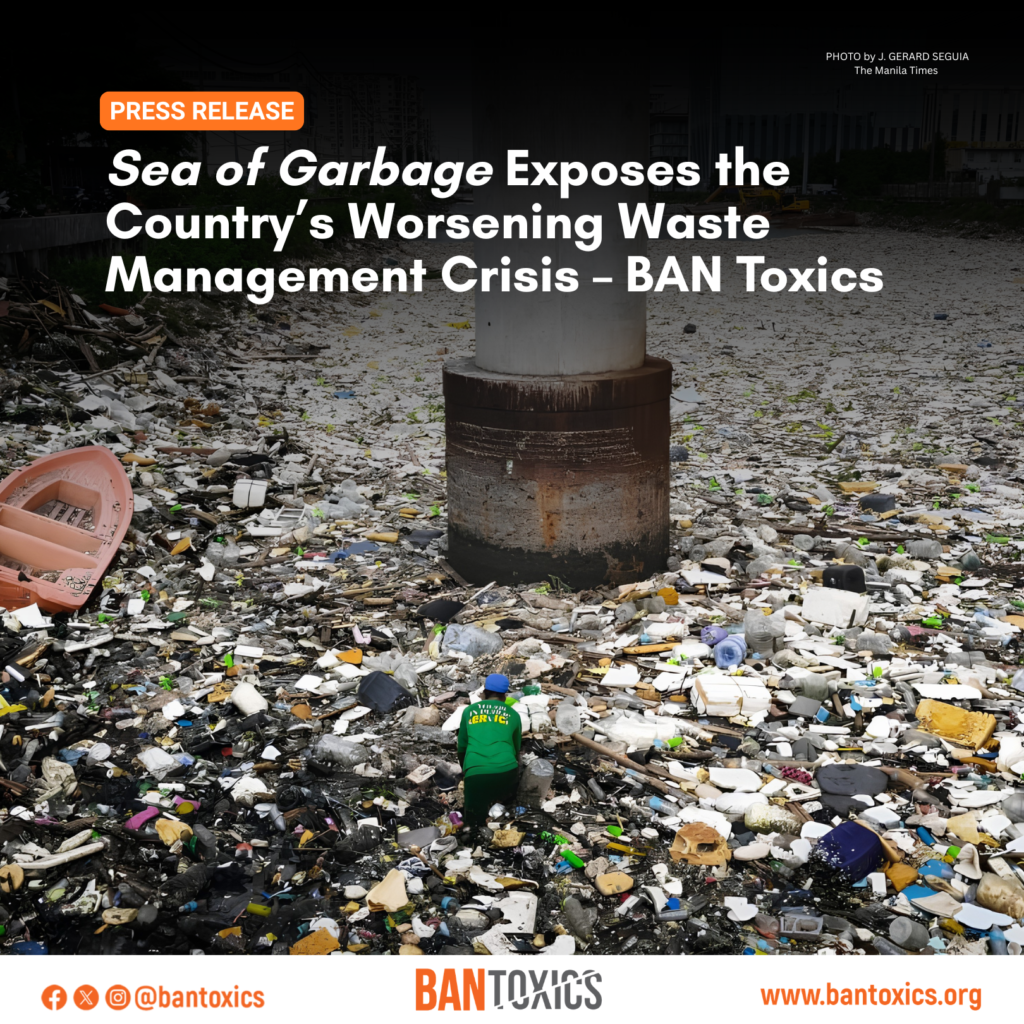
Following days of heavy rains brought by the southwest monsoon, images of garbage piling up and floating in parts of Parañaque City have once again exposed the country’s persistent waste management crisis.
The environmental justice group BAN Toxics calls out recent pronouncements from Malacañang emphasizing the supposed lack of discipline and irresponsibility of ordinary Filipinos. According to the group, such statements risk shifting the burden of a systemic problem onto the public while failing to address the government’s responsibility to fully implement the country’s solid waste management laws.
“We recognize that proper waste management requires the participation of every citizen. However, individual accountability cannot be used as an excuse for the government’s failure to fulfill its responsibilities. The government has the mandate, resources, and legal obligations to establish systems that make proper waste management possible and accessible,” said Thony Dizon, Advocacy and Campaign Officer of BAN Toxics.
“We also urge the government and Local Government Units (LGUs) to strengthen public education on proper waste management. Yes, waste management is a shared responsibility, but it can only be achieved through proper education and access to adequate waste facilities,” Dizon said.
BAN Toxics calls for a comprehensive review of the implementation of the Ecological Solid Waste Management Act of 2000 (RA 9003) and stronger enforcement measures amid the worsening waste crisis.
RA 9003 requires the LGUs to plan, implement, and finance localized solid waste management programs, including mechanisms for waste reduction, recovery, recycling, and diversion. Yet challenges such as improper waste disposal, inadequate infrastructure, and gaps in public awareness persist, underscoring the need for stronger implementation of the law.
The law mandates LGUs to establish a Materials Recovery Facility (MRF) in every barangay or cluster of barangays. However, according to the Compendium of Philippine Environment Statistics (CPES), the country had only 20,458 MRFs in 2025, highlighting a significant gap in the implementation of the law given that there are more than 42,000 barangays nationwide.
According to the group, LGUs must also be held accountable for failing to implement RA 9003 and comply with their 10-year Solid Waste Management Plans, including their obligations on waste diversion.
Under the law, LGUs are required to divert at least 25% of solid waste from disposal facilities through practices such as reuse, recycling, composting, and other resource recovery measures. However, waste diversion and recovery efforts often rely heavily on informal channels, including junk shops and the work of waste collectors and waste pickers.
“Informal waste workers segregate waste, recover recyclable materials, and earn a living from discarded materials. We must recognize their vital role in waste recovery and recycling,” Dizon said.
BAN Toxics calls for their formalization and integration into local solid waste management systems, with access to social and health benefits, training, support, proper facilities and equipment, and safe and decent working conditions.
“RA 9003 is crucial but poorly implemented, and its shortcomings are evident, particularly during floods. With plastics comprising a significant share of the country’s generated waste, improper waste management can lead to toxic contamination, posing hidden and long-term risks to communities and the environment,” Dizon said.
Based on the latest DENR report, the Philippines’ estimated waste generation reached 60.76 thousand tons per day in 2025. DENR data from 2024 also showed that the country generated approximately 61,000 metric tons of solid waste daily, with up to 24 percent consisting of plastic waste, primarily from consumer goods packaging, cutlery, and shopping bags.
BAN Toxics calls for the reduction of plastic use, particularly single-use plastics. The national government and LGUs must lead efforts to reduce dependence on disposable plastics and support accessible, affordable, and environmentally sound alternative packaging systems.
As of 2019, about 30% of LGUs had some form of policy regulating the use of single-use plastics, according to the National Solid Waste Management Commission (NSWMC). This leaves over 70% of LGUs without localized policies to stop plastic pollution at the source. There is currently no comprehensive nationwide legislative ban on specific single-use plastic products, leaving local government action fragmented and insufficient to address the scale of plastic pollution.
“These gaps in waste management and the recurring impacts of flooding also point to the need for greater accountability in the allocation of public resources and implementation of flood-control projects,” Dizon added.
“Any allegations of corruption, irregularities, or misuse of funds in flood-control projects must be investigated transparently, and those responsible must be held accountable. Public funds intended for flood protection must reach the communities they are meant to protect,” Dizon said.
BAN Toxics also rejects the growing promotion of waste-to-energy (WTE) technologies as a purported solution to the country’s waste crisis, a direction further reinforced by President Marcos Jr.’s State of the Nation Address (SONA).
“Framed as a renewable energy source, waste-to-energy is a false solution to address the root causes of waste generation. Burning waste contributes to greenhouse gas emissions and can release hazardous pollutants,” Dizon explained.
As an alternative, BAN Toxics calls for institutionalizing zero-waste approaches to address the waste crisis, centered on waste reduction and plastic elimination at the source. #
(Photo courtesy: J. GERARD SEGUIA / The Manila Times)